What You Don't Say Is the Whole Point: Finding Power in Stillness and Silence Onstage
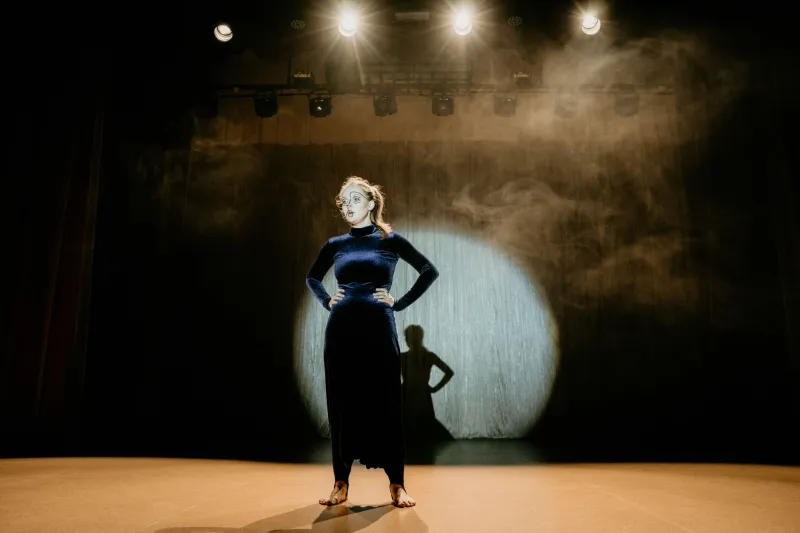
There's this moment that happens in really good theater. The actor hasn't said anything for a few seconds. Maybe they've just received devastating news, or they're looking at someone they've loved for decades across a kitchen table. And the audience — without knowing why — holds its breath.
Nothing is happening. And everything is happening.
We live in a culture that equates volume with value. Bigger gestures, bigger emotions, bigger voices. And sure, there's a place for all of that. But some of the most gut-wrenching, soul-rearranging performances you'll ever witness? They happen in the space between the words.
Learning to work with silence — to genuinely trust it — is one of the hardest and most rewarding things a performer can do. It's also one of the most authentically human.
Why We're Afraid to Stop Talking
Most performers, especially early in their training, treat silence like a problem to solve. A pause feels like forgetting your lines. Stillness feels like doing nothing. And doing nothing feels terrifying when you're standing under a spotlight in front of two hundred people.
But that fear? It's worth examining, because it doesn't just live onstage. It shows up in rehearsal rooms, in audition hallways, in the way we talk about ourselves and our art. We fill space because empty space feels vulnerable. We keep moving because stopping means people might actually see us — really see us — without the noise to hide behind.
Here's the thing though: audiences are wired to read stillness. Human beings have been interpreting each other's non-verbal signals for hundreds of thousands of years. When a performer goes quiet and stays present, the audience leans in. Their nervous systems are paying attention in a completely different way than when someone is actively performing at them.
Silence creates invitation. It says: come closer, look harder, feel this with me.
Subtext Is the Real Text
Every script, every choreographed piece, every improvised set has a surface layer and an underneath layer. The surface is what's being said or danced or sung. The underneath — the subtext — is what's actually going on.
Two characters arguing about who forgot to buy groceries aren't really arguing about groceries. A dancer moving through a repetitive phrase isn't just executing choreography. A comedian landing a joke isn't just being funny. There's always something running beneath.
Subtext lives in the body. It lives in the micro-expressions that cross a face before the mask goes back up. It lives in the way a hand reaches toward someone and then pulls back. It lives in the beat of silence after a line lands — that half-second where the character processes something they don't want to feel.
When performers trust their subtext, they stop trying to illustrate the emotion and start actually experiencing it. That's a massive shift. The audience can feel the difference immediately, even if they can't articulate why. They just know that what they're watching is real.
Practical Ways to Find Your Still Center
Okay, so how do you actually get there? How do you train yourself to sit inside a pause without panicking or over-explaining it with your face?
Start with breath. Before you can be still onstage, you have to know what it feels like in your body to genuinely settle. Try this in rehearsal: after delivering a line, instead of immediately moving to the next one, take one full breath. Not a performed breath — a real one. Notice what happens to the scene when you do that. Nine times out of ten, it deepens.
Listen like you've never heard it before. One of the biggest culprits behind over-performing is listening on autopilot. You know what your scene partner is going to say, so you're already preparing your response instead of actually receiving their words. Try this: every time you're in a scene, commit to hearing each line as if it's the first time. Your body will respond differently. Your stillness will mean something.
Let your eyes do the heavy lifting. Eyes are endlessly expressive and wildly underused. Instead of adding gesture or movement when you want to convey something complex, try taking everything else away and just letting your eyes hold the moment. This works in dance too — where you direct your gaze completely changes the emotional texture of a phrase.
Choreograph your pauses. This sounds counterintuitive, but it works. Identify two or three moments in your piece where silence could live. Give those moments specific internal thoughts or images — something vivid and personal that you actually have to process. The pause becomes active rather than empty. It has weight.
What Dance Knows That Acting Sometimes Forgets
Dancers often have an easier time with stillness because the form demands it. In contemporary and modern dance especially, the held position — the suspended moment before a fall or a turn — is understood to be as choreographically significant as the movement itself.
The stillness is part of the phrase. Not a break in it.
Actors can borrow this framework. Think of your silence not as a gap between the real stuff, but as part of the performance itself. The pause after the confession. The moment of looking before the goodbye. These aren't empty — they're full. They're just full of something that doesn't have words.
Some of the most celebrated American theater directors — people like Anne Bogart and her SITI Company work, or the physical theater traditions coming out of programs at NYU and CalArts — have built entire methodologies around this idea. The body in stillness is not a body at rest. It's a body in tension, in thought, in feeling. It's doing everything.
Authentic Expression Lives in the Quiet
Here at Just Be You Performing Arts, we talk a lot about authentic expression — what it means to actually bring yourself to the stage rather than a polished version of what you think a performer should look like. And here's something we've noticed: authenticity tends to be quieter than performance.
When people are genuinely moved, they go still. When someone receives truly shocking news, they don't immediately start gesturing. When you're sitting with someone you love in a hard moment, the most meaningful thing is often just being there — present, quiet, fully felt.
The stage is a magnifying glass. Whatever you bring to it gets amplified. And when you bring genuine stillness — not checked-out stillness, not frozen stillness, but alive, present, listening stillness — it hits audiences somewhere deep.
You don't have to fill every moment. You don't have to be the loudest thing in the room to be the most powerful. Sometimes the bravest, most expressive thing you can do is stop. Breathe. Let yourself be seen in the quiet.
That's not doing less. That's doing everything.