Every Stumble Is a Scene: What Your Worst Performances Are Really Trying to Tell You
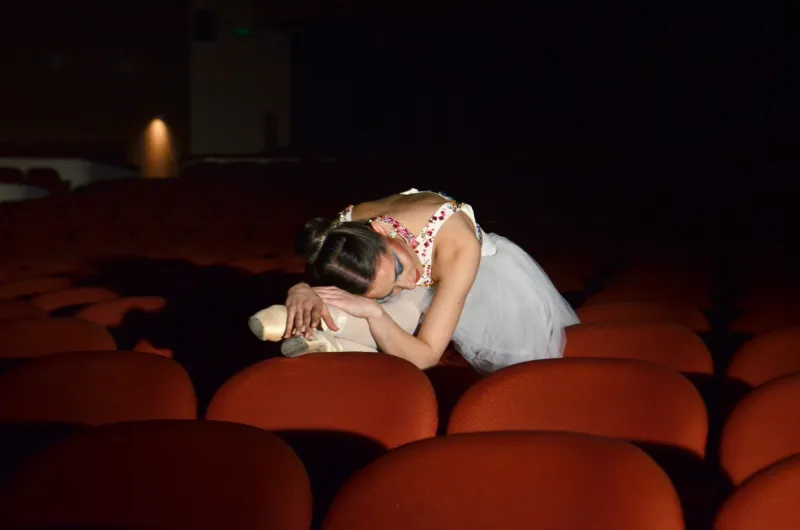
Let's be honest for a second. You probably remember your worst performance more vividly than your best one.
Maybe it was a community theater production where you walked onstage too early and stood there, frozen, while another actor desperately tried to improv around you. Maybe it was a dance recital where your mind just... left the building, and your feet followed a beat that only existed in some parallel universe. Or maybe you delivered a monologue so stiffly that you could practically hear the audience shifting in their seats.
Whatever your particular flavor of stage disaster, here's what nobody tells you when you're standing in the wings wanting to dissolve into the floorboards: that moment is working for you, not against you.
The Brain Doesn't Learn From Smooth Sailing
There's solid psychological research behind why failure is such a powerful teacher. When we make mistakes — especially public, high-stakes ones — our brains light up differently than when things go according to plan. The emotional charge of a stumble essentially burns the lesson deeper into our memory. Cognitive scientists call this "error-driven learning," and performers experience it in a very specific, very visceral way.
Live performance is unique because it strips away every safety net. You can't pause, rewind, or edit. The rawness of that exposure is exactly what makes a bad night on stage so uncomfortable — and exactly what makes it so instructive. When something goes wrong in front of a real audience, you're forced to problem-solve in real time, recalibrate your instincts, and discover what you're actually made of under pressure.
That's not failure. That's advanced training.
"I Wanted to Quit That Night"
Samara, a Chicago-based musical theater performer who's been working the regional circuit for nearly a decade, remembers a production of Into the Woods where she entered on the wrong cue and launched into her song a full eight bars early. The band stopped. The conductor stared. The audience went quiet in that particular way that makes time feel elastic.
"I genuinely considered just walking off the stage," she says, laughing now in a way that took years to develop. "But I didn't. I made eye contact with someone in the front row, took a breath, and we started again. And honestly? That moment taught me more about stage presence than any acting class I've ever taken. I learned that I could survive the silence. I learned that the audience wants you to recover."
That experience rewired something in her. She stopped performing with the low-grade terror of what might go wrong and started performing with a quiet confidence that she could handle whatever did.
Rehearsals Are Supposed to Be Ugly
There's a culture in some performing arts spaces — particularly those shaped by perfectionism and competitive environments — where stumbling in rehearsal feels almost as shameful as stumbling in performance. People apologize constantly. They over-explain their mistakes. They perform their self-criticism before anyone else can get there first.
But here's the thing: a rehearsal room where nobody ever falls apart is a rehearsal room where nobody is actually trying anything new.
The clumsy, uncertain, "this feels wrong and I don't know why" phase of learning a role or a piece of choreography isn't a detour from the process. It is the process. The awkwardness is the body and mind negotiating new information, testing limits, building muscle memory through repetition and correction.
Directors and choreographers who've worked with performers long enough will tell you that they're often more interested in watching someone work through difficulty than watching someone execute perfectly. Struggle reveals instinct. Struggle reveals character. And in a performing arts space that centers authentic expression — like the one we're all building here at Just Be You — that kind of real, unpolished effort is genuinely worth celebrating.
Reframing the "Disaster" Narrative
One of the most useful mental shifts a performer can make is learning to separate the story they tell about a bad performance from the performance itself.
The story usually sounds something like: I messed up. I embarrassed myself. Everyone saw. I'm not good enough.
But what if the story sounded more like: Something unexpected happened. I responded to it. Now I know something I didn't know before.
That's not toxic positivity or pretending the cringe didn't happen. It's a more accurate account of what actually went down. You performed. Things went sideways. You kept going. You learned.
Marcus, a dance educator based in Atlanta who teaches teens through a community arts program, has built this reframe into how he runs his classes. "I actually celebrate the mess-ups out loud," he says. "If a student falls out of a turn, I'll say, 'Yes! You found the edge of it. Now you know where it is.' Because that's the truth. You can't learn your limits without bumping into them."
His students, he says, are noticeably less afraid to try hard things than students who've been trained in environments where mistakes are treated as problems to be minimized.
The Long Game of Getting Good
Every performer you admire — the ones who seem effortless, the ones who make it look like breathing — has a blooper reel that would make your jaw drop. The difference between them and someone who quit isn't talent. It's tolerance for the uncomfortable middle ground between trying and mastering.
The awkward phase doesn't end after your first year of performing, or your fifth, or your twentieth. It just changes shape. You get better at recognizing it, sitting with it, even welcoming it a little — because you've learned what comes after.
Every bad performance is a door. You can stand outside it, mortified, cataloging everything that went wrong. Or you can walk through it and find out what's on the other side.
Spoiler: it's a better version of your craft.
So the next time you blank on a line or miss your mark or accidentally knock over the set piece your stage manager spent three hours building — take a breath. You're not failing at performing. You're performing the most essential part of it.
You're learning how to be real, in real time, in front of real people.
And honestly? That's the whole point.