Stage Left, On Purpose: How Performers Are Finding Their Truest Voice Behind the Scenes
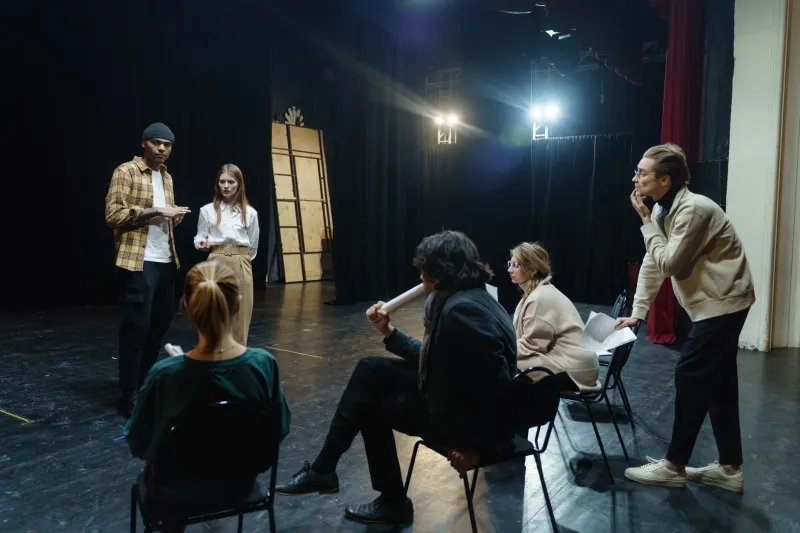
The performing arts world has a complicated relationship with the idea of "making it." For most people outside the industry — and honestly, for a lot of people inside it — success looks like one thing: you, center stage, under a follow spot, taking a bow. Everything else is a stepping stone or a fallback.
But spend any real time in theater, dance, or live performance, and you start to notice something. Some of the most creatively alive, artistically fulfilled people in the room aren't the ones in the lights. They're the ones in the booth, in the wings, in the production meetings, in the community outreach office. And increasingly, they got there on purpose.
The Myth of the One True Path
The narrative around performing arts careers is deeply — almost stubbornly — performer-centric. Training programs spend the vast majority of their time preparing students to audition, to perform, to sustain a life in front of audiences. The implicit message is clear: performing is the goal. Everything else is infrastructure.
That framing does a quiet kind of damage. It means that performers who discover a passion for directing often wonder if they're "giving up." Stage managers who started as dancers sometimes feel like they've drifted off course. Arts administrators who trained as actors carry an unspoken sense that they ended up somewhere they weren't supposed to be.
Tamara, who spent eight years as a working actress in regional theater before transitioning into dramaturgy and eventually becoming the literary manager at a mid-size theater company in Minneapolis, describes the shift as "the most artistically honest thing I'd ever done — and the hardest to explain to my family."
"Everyone kept asking when I was going back to performing," she says. "But I wasn't going back. I'd found the thing that actually let me do the work I cared about most."
What's Actually Happening Behind the Curtain
The growth of performers intentionally moving into off-stage roles isn't accidental. It's a response to real limitations in the industry and real desires that the performance track doesn't always address.
For some artists, the issue is longevity. Performing careers — especially in dance — are often physically time-limited in ways that careers in directing or administration simply aren't. Moving behind the scenes isn't retreat; it's sustainability.
For others, it's about scope. Performing gives you influence over one role, one body, one story at a time. Directing gives you the whole room. Dramaturgy lets you shape how a script is understood and contextualized before an audience ever sees it. Arts administration — unglamorous as it sounds — determines which stories get produced at all, which communities get served, which artists get resources. That's enormous creative and cultural power.
Devon, a former musical theater performer who now serves as the executive director of a performing arts nonprofit in the Pacific Northwest, is direct about why he made the switch: "I wanted to change what was possible for artists who looked like me. You can't do that from one role. You do it by controlling the budget, the season, the hiring, the mission."
The Authenticity Angle Nobody's Talking About
Here's where it gets interesting from a Just Be You perspective: for many performers, off-stage roles aren't a compromise of their authentic artistic identity. They're an expression of it.
Authenticity in the arts gets framed almost exclusively around performance — the idea that being true to yourself means being visible, being seen, being onstage. But authenticity is about alignment between who you are and what you do. And for some artists, who they are is a storyteller, a community builder, a mentor, a systems thinker. The stage was never going to be the fullest expression of that.
Tamara talks about the moment it clicked for her: "I was in a dramaturgical meeting, helping a playwright understand the historical context of their own script, watching the lightbulb go on — and I felt more like myself than I had in years of performing. That was the data I needed."
This is also showing up generationally. Younger performers — particularly those from BIPOC communities, working-class backgrounds, and other historically underrepresented groups — are increasingly entering the industry with an eye toward structural influence, not just individual visibility. They're asking not just "how do I get on stage?" but "how do I help change who gets on stage and what stories get told there?"
Mentorship as Creative Practice
One of the most consistent themes among performers who've built careers behind the curtain is the centrality of mentorship. When you're performing, your creative energy is largely directed inward — toward your own craft, your own development, your own presence. When you step into directing, stage management, or arts administration, a significant portion of that energy redirects toward other people's growth.
For many artists, that turns out to be profoundly meaningful in a way that performing alone never was.
"I get to watch someone figure out something about themselves through this work, and I get to be part of that," says Devon. "That's not less than performing. For me, honestly? It's more."
Stage managers — often the most underrecognized artists in any production — describe their role in similar terms. Holding the emotional and logistical container for a production, being the person the whole cast and crew can rely on, calling cues in the dark while something beautiful happens onstage: it requires a kind of creative presence that's just as demanding as performing, and just as rewarding.
So What Does Success Actually Look Like?
Maybe the most radical thing we can say at Just Be You Performing Arts is this: success in the performing arts doesn't have a single shape. The follow spot is one way to be in the work. It's not the only way. It might not even be the most powerful way.
If you're a performer who's felt the pull toward directing, toward production management, toward advocacy, toward education — that pull is worth following. It's not a detour. It might be the most direct route to the work you were actually meant to do.
The curtain is just a piece of fabric. The real action has always been on both sides of it.