The Mask You Wear When the Lights Go Down
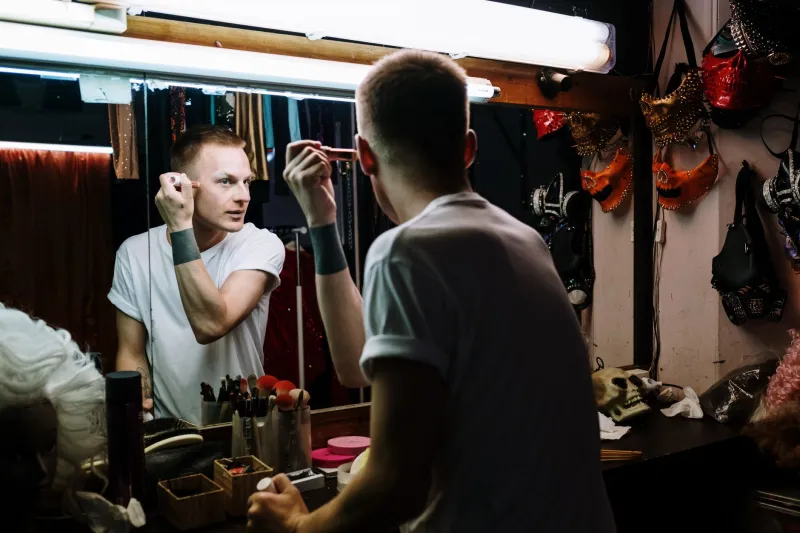
There's a particular kind of irony that lives backstage. A dancer can move an audience to tears with a solo that lays bare grief, longing, or joy — and then walk offstage and struggle to tell a close friend how their week actually went. An actor can cry on cue, scream into the dark, confess a character's worst secrets to a thousand strangers — and then freeze when someone they love asks, "Are you okay?"
This isn't rare. It's almost a rite of passage in the performing arts world. And it has a name, even if nobody's officially coined it yet: the authenticity paradox.
When the Character Is Safer Than the Self
Ask almost any seasoned performer and they'll tell you — playing someone else can feel weirdly liberating. When you're inhabiting a role, the stakes shift. The emotions are real, but they belong to the character. The vulnerability is genuine, but it's protected by a layer of craft.
"There's a permission structure built into performance," says Chicago-based acting coach Renata Delgado. "You've been given the text. You've been given the character. You have a director, a script, a set. When you're just yourself at dinner with your family, none of that scaffolding exists. It can feel completely terrifying."
For performers who grew up using theater or dance as a refuge — a place to feel things they couldn't express at home or in school — that scaffolding isn't just helpful. It becomes load-bearing. The stage becomes the only room where authenticity feels safe enough to exist.
The Training That Teaches You to Feel (But Not to Share)
Here's where it gets complicated. Most performing arts training is explicitly designed to access emotion. Stanislavski's emotional memory. Meisner's living truthfully under imaginary circumstances. Laban movement analysis for dancers. These methods ask artists to dig deep, to stay present, to drop their defenses.
But the context is always controlled. There's a scene partner. There's a structure. There's an end of rehearsal.
Off stage, life doesn't offer that kind of container. And for performers who have spent years learning to perform authenticity — to make it look and feel real to an audience — there's a subtle but real risk: the skill of expressing emotion can quietly replace the habit of experiencing it without an audience present.
"I didn't realize for years that I was performing even in my closest relationships," admits Marcus Webb, a New York-based musical theater performer who's been working professionally for over a decade. "I knew how to be emotionally available in a scene. But in real life, I was watching myself from the outside. I was giving people the version of Marcus that I thought they wanted, not the actual one."
Marcus isn't alone. This kind of emotional outsourcing — using performance as the primary channel for authentic feeling — shows up across disciplines. Dancers who can express physical vulnerability in movement but shut down in verbal communication. Comedians who deflect every serious moment with a joke. Singers who pour their hearts into lyrics written by someone else but go quiet when asked to speak their own truth.
The Audience Problem
There's another layer here that doesn't get talked about enough: the role of the audience in creating safety.
In performance, there's an implicit social contract. The audience has paid — literally or figuratively — to witness your expression. They are expecting you to feel things. They are, in a sense, rooting for your vulnerability. That kind of permission is intoxicating.
In everyday life? Nobody signs up for that. A partner, a parent, a friend — they have their own needs, their own discomforts, their own stuff. There's no guarantee they'll receive your honesty with warmth. And for performers who have been conditioned to read a room and adjust accordingly, that unpredictability can feel genuinely threatening.
"A lot of my students are people-pleasers at their core," says Delgado. "That's partly why they became performers. They learned early how to read what a room needs and give it. The problem is, that skill can become a wall between you and the people who actually love you."
Bridging the Gap — Without Losing the Gift
The good news? The same instincts that make someone a compelling performer can be gently retrained to support real-life connection. The goal isn't to strip away the artistry — it's to stop treating it as the only available mode.
Some performing arts programs are beginning to address this directly. Workshops that blend acting technique with somatic therapy practices. Dance companies incorporating community circles and verbal processing into rehearsal culture. Acting coaches who explicitly discuss the difference between performing emotion and inhabiting it.
For individuals, the shift often starts with a simple but uncomfortable question: Who am I when nobody's watching?
Marcus says his turning point came during a period when he wasn't working. "I had no shows, no auditions, no rehearsals. And I realized I had no idea how to just... be. I'd built my whole identity around what I could do, not who I was. That was the beginning of actually getting to know myself."
Delgado offers a practice she calls "dropping the fourth wall" — a daily exercise where performers consciously choose one interaction to enter without any performance intention. No managing the impression. No reading the room. Just showing up as themselves and seeing what happens.
"It's uncomfortable at first," she admits. "But that discomfort? That's actually the same place where the best performances come from. When you stop performing and start being — that's where the real stuff lives."
The Stage as a Starting Point, Not a Finish Line
At Just Be You Performing Arts, we believe the stage should be a place where you discover who you are — not the only place you're allowed to be it. The courage it takes to stand in front of an audience, to feel something real under those lights, to let a room full of strangers see you? That courage doesn't belong to the character. It belongs to you.
The paradox isn't a flaw in the performer. It's an invitation. A signal pointing toward the work that exists beyond the script — the quieter, messier, more personal work of learning to be real in your own life, not just on someone else's stage.
You already have everything you need to do it. You've been practicing for years.