When Your Art Meets Someone Else's: Navigating the Beautiful Mess of Ensemble Work
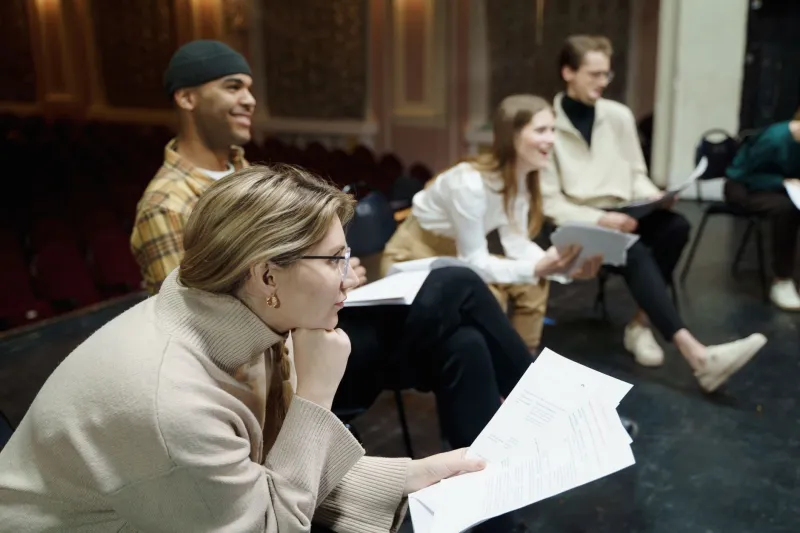
There's a particular kind of panic that hits solo performers the first time they step into a true ensemble. You've spent years — maybe a decade — sharpening your instincts, trusting your gut, building a creative voice that is unmistakably yours. And then suddenly you're in a room with five other people who've done the exact same thing. And someone's asking everyone to make something together.
Welcome to the collaboration paradox.
It's one of the most honest tensions in the performing arts: the same self-awareness and creative ownership that makes a performer compelling can also make them genuinely difficult to work with. Not because they're bad people. Because they care — deeply, fiercely — about the work.
The Ego Isn't the Enemy (Sort Of)
Let's get something out of the way: ego gets a bad rap in collaborative spaces. Directors preach about "checking your ego at the door" like it's some kind of spiritual prerequisite for ensemble work. But here's the thing — the ego, properly understood, isn't the problem. A complete absence of artistic ego produces performers who are technically competent and creatively invisible.
Marcos, a contemporary dancer based in Chicago who spent six years performing as a solo artist before joining a mid-size dance theater company, puts it plainly: "I didn't have an ego problem. I had a translation problem. I knew exactly what I wanted to say with my body, but I had no language for how to say it with someone else without one of us disappearing."
That translation problem is where most solo-to-ensemble transitions actually break down. It's not about ego versus humility. It's about developing a whole new creative vocabulary — one that includes other people's instincts as genuine inputs rather than obstacles.
Control Is Just Fear in a Nice Outfit
Ask any performer who's struggled in collaborative settings and eventually — if they're being honest — the conversation finds its way to control. The need to know what the piece is going to look like. The anxiety of not being able to predict the outcome. The low-grade terror of trusting another person's creative choices with something that matters to you.
Nadia, a theater actress from Atlanta who transitioned from one-woman shows to ensemble drama in her late twenties, describes her first major collaborative production as "a master class in realizing how much of what I called 'artistic integrity' was actually just fear of being changed."
"I kept saying things like, 'That doesn't feel true to the character,' when what I actually meant was, 'That doesn't feel true to my version of the character that I've been building alone in my apartment for three weeks,'" she laughs. "Those are very different things."
The shift she eventually made — and that many performers describe as genuinely transformative — was learning to distinguish between the non-negotiable core of her artistic identity and the preferences she'd mistaken for principles.
Practical Strategies That Actually Work
So how do you stay you while genuinely making space for someone else? A few approaches that performers have found useful:
Name your anchors before rehearsal starts. Before you step into an ensemble process, get clear on the two or three things that are truly non-negotiable about how you work and what you value artistically. Not a list of twenty. Two or three. When you know what you're actually protecting, you can let everything else be genuinely flexible.
Treat your scene partner's impulses as information. When another performer does something unexpected, the instinct is often to redirect or reinterpret it back toward your own vision. Try sitting with it instead. Ask what they're seeing in the scene. You don't have to use it — but you might find it opens a door you didn't know was there.
Talk about the work, not the performance. One of the most common breakdowns in ensemble settings happens when feedback gets personal. "That choice didn't land" is a conversation. "You're not listening to me" is a fight. Keeping the dialogue focused on the work itself — the scene, the story, the moment — creates space for honest exchange without people feeling attacked.
Let yourself be moved. This one sounds soft, but it's actually where the magic lives. The performers who thrive in ensemble work aren't the ones who successfully impose their vision on the group. They're the ones who are genuinely affected by what their collaborators bring. Real connection on stage almost always starts with real curiosity off it.
The Thing Nobody Tells You About Shared Stages
Here's what the most experienced ensemble performers will eventually admit: collaboration doesn't dilute your artistic identity. Done right, it reveals it.
When you're working alone, you can get away with a lot of comfortable habits and unexamined assumptions. Ensemble work has a way of holding up a mirror. The moments where you dig your heels in, the instincts that survive contact with other people's perspectives, the creative choices that hold up even when someone pushes back — those are the truest map of who you actually are as an artist.
Marcos says his years in ensemble work taught him more about his own movement vocabulary than his solo practice ever did. "Working with other bodies showed me what was distinctly mine. I didn't know what my artistic fingerprint looked like until I had something to compare it to."
Nadia puts it even more directly: "I thought collaboration was going to compromise me. It turned out to be the thing that finally made me stop compromising with myself."
The stage is big enough for more than one voice. The question isn't whether you can hold onto yourself while sharing it. The question is whether you're willing to find out what you're actually made of when you do.